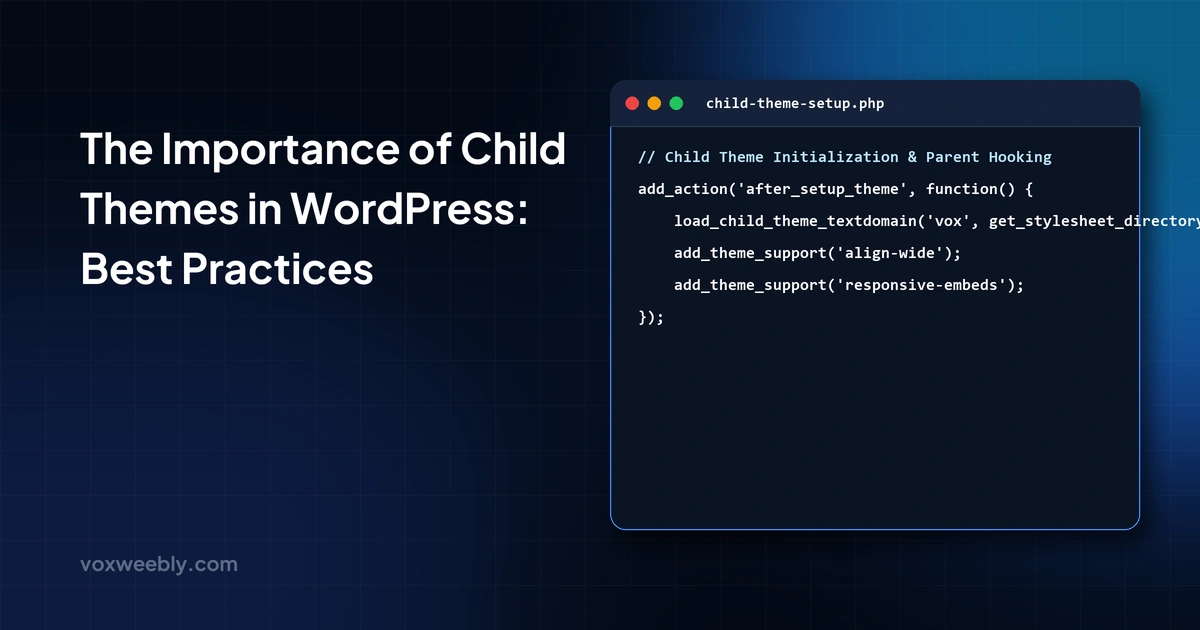
In professional WordPress development, editing a parent theme directly is the ultimate architectural sin. The moment a theme author pushes an update to patch a security flaw or introduce new styling, all custom PHP hooks, CSS tweaks, and template overrides written inside the parent theme are irrevocably erased. A WordPress child theme solves this problem completely by decoupling your bespoke customizations from the parent theme codebase. In this comprehensive technical guide, we break down why a child theme is mandatory for every serious website, how the WordPress template hierarchy processes child overrides, and how to maintain high-performance child themes.
1. Why a Child Theme is Non-Negotiable
A child theme inherits 100% of the parent theme’s functionality, templates, and styles while providing a safe, isolated directory for your custom code. It delivers three indispensable benefits:
- Update Immunity: When the parent theme is updated, your child theme files remain completely untouched.
- Code Cleanliness: Custom business logic is separated from third-party vendor code, simplifying Git version control and collaborative agency workflows.
- Effortless Rollbacks: If a custom snippet causes issues, you can comment it out inside your child theme or deactivate the child theme without reinstalling the parent theme.
Learn the exact mechanics of creating your first child theme in our step-by-step tutorial on how to create a WordPress child theme. For foundational coding principles, consult the WordPress Developer Child Theme Documentation.
2. How the WordPress Template Hierarchy Executes Overrides
When a visitor requests a URL, WordPress walks down its template hierarchy tree looking for the most specific template file. If a child theme is active, WordPress inspects the child theme directory first. For example, when rendering a single post:
- WordPress checks for
child-theme/single.php. If found, it executes immediately. - If not found in the child theme, it falls back to
parent-theme/single.php. - If missing in both, it falls back to
index.php.
This fallback architecture allows you to selectively customize individual components (such as header.php or footer.php) while leaving the rest of the parent theme’s templates fully automated. To explore building complete standalone themes, check out our guide on creating custom WordPress themes.
3. Clean Asset Enqueuing vs. Legacy Anti-Patterns
Never use CSS @import inside your child theme stylesheet. In modern Core Web Vitals audits, @import introduces blocking render waterfalls that degrade Largest Contentful Paint (LCP) by hundreds of milliseconds. Instead, enqueue parent and child stylesheets using the official wp_enqueue_scripts hook inside functions.php:
// Enqueue parent and child stylesheets cleanly
function voxweebly_enqueue_child_theme_assets() {
    wp_enqueue_style( 'parent-theme-style', get_template_directory_uri() . '/style.css' );
    wp_enqueue_style( 'child-theme-style', get_stylesheet_directory_uri() . '/style.css', [ 'parent-theme-style' ], wp_get_theme()->get( 'Version' ) );
}
add_action( 'wp_enqueue_scripts', 'voxweebly_enqueue_child_theme_assets' );
For more asset loading speed benchmarks, see our developer analysis on disabling lazy load on primary banners.
4. Understanding functions.php Execution Order
Unlike template files that replace their parent equivalents, functions.php behaves differently. WordPress executes the child theme’s functions.php first, followed immediately by the parent theme’s functions.php. This enables you to define pluggable functions or modify hooks before parent logic boots.
5. Modular Architecture for Custom Hooks & Styles
Avoid dumping hundreds of disparate PHP functions into a single monolithic functions.php file. Maintain a clean modular folder structure inside your child theme:
child-theme/
├── inc/
│   ├── security-headers.php
│   ├── custom-post-types.php
│   └── woocommerce-hooks.php
├── functions.php
└── style.css
Include security headers directly from your child theme by reviewing our step-by-step tutorial on adding HTTP security headers in WordPress, and safeguard your server origin against automated bot attacks with our guide on blocking AI automated vulnerability scanners.
Conclusion
In conclusion, mastering the importance of child theme in wordpress: why you should always use one is essential for building a resilient, high-performing WordPress website. By implementing the architectural best practices and configurations covered in this guide, you ensure your platform maintains peak performance, bulletproof security, and seamless user experiences.
Continuously auditing your server configurations, monitoring error logs, and adhering to clean development standards will keep your site reliable as your business scales. Investing in high-performance hosting and modern engineering prevents costly downtime and maximizes your digital investment.
At Vox Weebly, we understand the importance of a fast, secure, and custom-engineered WordPress website, and our team of senior developers can help you build, optimize, and maintain your web platform for maximum performance. Contact us today to learn more about our custom WordPress website development services.
6. Frequently Asked Questions (FAQ)
Can I have a child theme of a child theme?
No. WordPress core architecture strictly does not support grandchild themes. You can only attach a child theme directly to a root parent theme.
What should I do if a child theme code error breaks my site?
If a custom PHP snippet triggers a white screen or fatal error, connect via SFTP and rename your child theme folder to regain access, then inspect debug.log. Review our complete troubleshooting walkthrough on fixing common WordPress errors.
Best Practices for Child Theme Template Customization
When overriding parent theme templates, follow the principle of least privilege. Rather than copying twenty parent template files into your child theme directory, copy only the specific template file you intend to modify (such as single.php or archive.php). This ensures that when the parent theme author updates unaffected templates (such as search results or author archives), your website automatically inherits those improvements.
Furthermore, inspect parent theme templates for existing action hooks. Frequently, parent theme authors provide custom action hooks (such as do_action( 'parent_before_content' )) that allow you to inject custom business logic directly from your child theme’s functions.php without copying template files at all. For full architectural guidelines, consult the WordPress Official Template Hierarchy Documentation.
Asset Version Cache-Busting via filemtime()
When deploying custom CSS adjustments inside a child theme, visitor browsers often cache older stylesheets, preventing them from seeing your design modifications. Always pass filemtime() as the version argument inside wp_enqueue_style() to automatically bust browser caches whenever the stylesheet file is saved on disk.