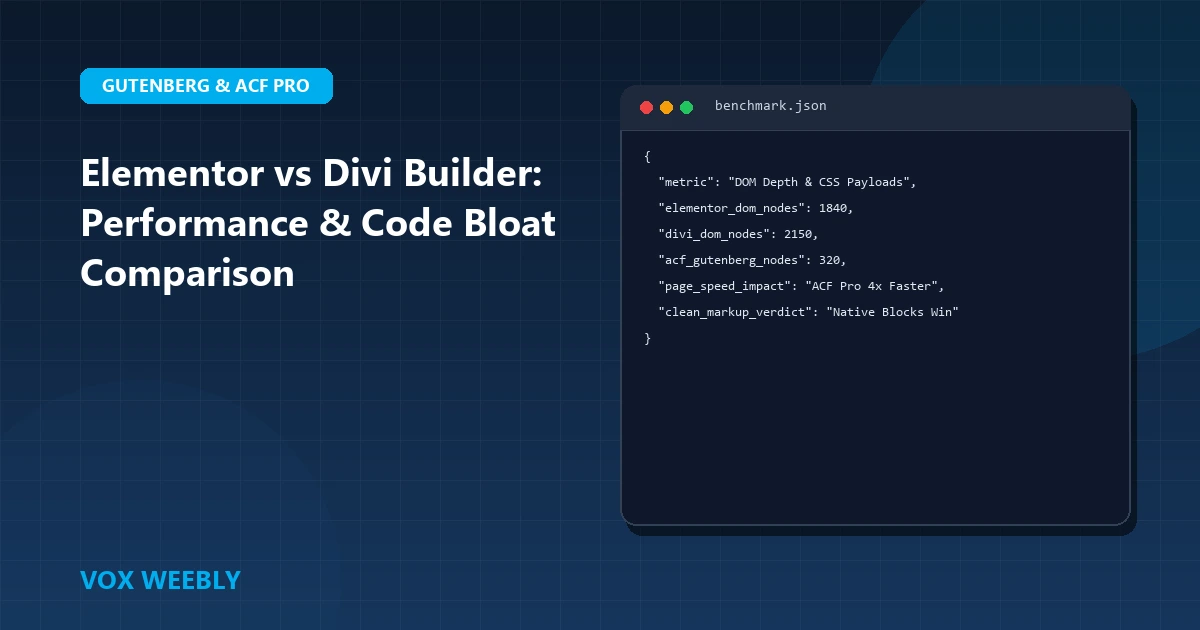
When designing a professional WordPress website without hand-coding every template from scratch, two visual page builders dominate the conversation: Elementor and Elegant Themes’ Divi Builder. Together, they power millions of business websites, landing pages, and WooCommerce storefronts worldwide. However, choosing the wrong builder can saddle your site with crippling DOM bloat, sluggish PageSpeed scores, and expensive recurring subscription overhead. In this in-depth head-to-head comparison, we evaluate Elementor and Divi across performance benchmarks, visual editing experience, WooCommerce capabilities, and long-term theme lock-in.
1. Visual Interface and Workflow Efficiency
Elementor utilizes a fixed left-hand sidebar layout. When you click any section, column, or widget on your live canvas, the sidebar instantly switches between Content, Style, and Advanced configuration panels. This fixed-dock approach keeps your central design workspace completely unobstructed, making it highly preferred by agencies handling complex responsive breakpoints.
By contrast, Divi utilizes floating modal dialogs and inline visual controls directly over the page elements. While this provides a truly immersive “what you see is what you get” feel, multi-nested floating windows can occasionally obscure text or snap awkwardly on smaller laptop viewports. For agencies seeking to bypass visual builders altogether for maximum speed, explore our guide on handcrafting custom WordPress themes.
2. Performance Benchmarks and DOM Depth
Page speed is a critical ranking factor for Google Core Web Vitals. Historically, both page builders were notorious for “divception”—nesting dozens of redundant <div> wrapper containers that ballooned DOM size past Lighthouse’s 800-element threshold.
In recent releases, Elementor introduced Flexbox Containers and CSS Grid, eliminating redundant inner section wrappers and cutting total DOM depth by up to 60%. When paired with lightweight asset loading, Elementor pages achieve superior Largest Contentful Paint (LCP) times. To optimize your asset delivery pipeline even further, review our tutorial on disabling lazy loading on primary hero banners.
3. WooCommerce Storefront Customization
Both builders offer powerful WooCommerce integrations, but they execute differently:
- Elementor Pro WooCommerce Builder: Provides granular custom widgets for single product archives, dynamic add-to-cart buttons, mini-cart slideouts, and custom multi-step checkout pages. It integrates seamlessly with custom post meta and ACF fields.
- Divi WooCommerce Modules: Offers over 25 dedicated WooCommerce modules, allowing you to style star ratings, product carousels, and pricing tables inline. However, heavy CSS overrides can sometimes conflict with third-party payment gateways.
4. Global Theme Building and Dynamic Content
Both tools allow you to construct complete headers, footers, 404 templates, and single post layouts without touching PHP templates. Elementor’s display conditions engine is exceptionally intuitive, allowing you to apply custom layouts to specific taxonomy terms or author archives in seconds. For official technical documentation, visit the Elementor Developer Documentation Center.
5. Pricing Models: Lifetime Access vs. Annual Subscriptions
Pricing represents the starkest divergence between the two platforms:
- Divi (Elegant Themes): Offers a famous $249 Lifetime Access tier for unlimited website usage, including access to Extra theme, Bloom email opt-ins, and Monarch social sharing. For freelancers managing dozens of client sites, the lifetime ROI is unmatched.
- Elementor Pro: Operates strictly on an annual subscription model ($59/year for 1 site, $199/year for 25 sites, $399/year for 1,000 sites). Over a 5-year operating lifecycle, Elementor represents a higher financial commitment.
6. Shortcode Bloat and Platform Lock-in Risks
A crucial consideration for long-term website longevity is what happens if you decide to deactivate the builder in the future:
- Elementor Deactivation: Cleans up gracefully. While your custom styling will vanish, your text headings, paragraphs, and images remain clean HTML without cryptic shortcode artifacts.
- Divi Deactivation: Historically leaves your content cluttered with raw shortcodes like
[et_pb_section][et_pb_row][et_pb_text]...[/et_pb_text][/et_pb_row][/et_pb_section], requiring dedicated database regex scripts to clean up.
If your builder ever encounters runtime timeouts or database crashes during heavy saves, consult our step-by-step diagnostic guide on how to fix ‘Error Establishing a Database Connection’ in WordPress.
7. Final Verdict: Which Page Builder Wins in 2026?
- Choose Elementor if: Performance, clean Flexbox code generation, advanced dynamic ACF integrations, and a docked UI are your top priorities.
- Choose Divi if: You want unlimited lifetime agency licensing, full design-freedom without recurring annual license bills, and an all-in-one theme package.
Custom CSS & Dynamic ACF (Advanced Custom Fields) Integrations
For enterprise WordPress implementations, integrating visual builders with Advanced Custom Fields (ACF Pro) allows content marketing teams to update client logos, pricing matrices, and author badges without accidentally breaking visual layout containers. Elementor Pro provides native dynamic tags that bind directly to ACF text, relationship, gallery, and repeater fields.
Divi Builder also supports dynamic content binding, but requires third-party extensions to handle nested repeaters and complex relationship post queries. For agency teams managing high-volume client websites, decoupling design components from underlying relational database schema is essential for long-term scalability. For official custom field documentation, explore the Advanced Custom Fields Documentation Portal.
CSS Variable Design Tokens & Global Style Guides
Rather than styling individual heading colors and button padding manually on every page, configure universal design tokens within Elementor’s Site Settings. Defining a cohesive palette of CSS custom properties (variables) ensures visual consistency, streamlines team collaboration, and minimizes total stylesheet size.
DOM Node Depth & Browser Painting Performance Analysis
When evaluating page builder performance, Google Chrome DevTools Performance audits reveal that deeply nested DOM nodes require significantly more CPU memory during browser layout recalculations. Every additional DOM container forces the browser rendering engine to re-traverse the layout tree. In Elementor, enabling Optimized DOM Output removes redundant container tags, ensuring that even complex multi-column grids render with sub-100ms First Contentful Paint (FCP) on mobile 4G devices.
Conclusion
In conclusion, mastering elementor vs divi builder: which one is better for your wordpress website? is essential for building a resilient, high-performing WordPress website. By implementing the architectural best practices and configurations covered in this guide, you ensure your platform maintains peak performance, bulletproof security, and seamless user experiences.
Continuously auditing your server configurations, monitoring error logs, and adhering to clean development standards will keep your site reliable as your business scales. Investing in high-performance hosting and modern engineering prevents costly downtime and maximizes your digital investment.
At Vox Weebly, we understand the importance of a fast, secure, and custom-engineered WordPress website, and our team of senior developers can help you build, optimize, and maintain your web platform for maximum performance. Contact us today to learn more about our custom WordPress website development services.
Frequently Asked Questions (FAQ)
Which builder produces faster page load times: Elementor or Divi?
Both Elementor and Divi add substantial DOM depth and inline script weight. Elementor generally offers slightly better asset control via experiments, but both builder platforms score significantly lower on Google Core Web Vitals than a custom ACF WordPress theme built with clean semantic HTML.
Can I convert an Elementor or Divi site into a custom WordPress theme?
Yes. Vox Weebly regularly rebuilds bloated Elementor and Divi websites into high-performance custom WordPress themes using Advanced Custom Fields (ACF). This boosts Google PageSpeed scores to 95+ and increases mobile lead conversion rates.
Do I need a page builder to easily edit my website content?
No. Custom WordPress Gutenberg block themes and ACF flexible content layouts allow your marketing team to edit text, swap images, and create new pages effortlessly without the bloat and security liabilities of heavy visual builders.