Are you looking to build a stunning e-commerce website for your business? Do you want a website that looks beautiful, is easy to navigate, and drives sales? If yes, then WordPress is the right platform for you. WordPress is a popular content management system that is widely used for building e-commerce websites. In this comprehensive guide, we will show you how to use WordPress to build a stunning e-commerce website for your business.
Step 1: Choose the Right E-commerce Plugin
The first step in building an e-commerce website with WordPress is to choose the right e-commerce plugin. There are several e-commerce plugins available for WordPress, but the two most popular ones are WooCommerce and Easy Digital Downloads. WooCommerce is a powerful and flexible e-commerce plugin that allows you to sell physical and digital products. On the other hand, Easy Digital Downloads is a lightweight plugin that is designed specifically for selling digital products. Choose the e-commerce plugin that best suits your needs.
Step 2: Choose a Suitable E-commerce Theme
After choosing the right e-commerce plugin, the next step is to choose a suitable e-commerce theme. Your theme will determine the look and feel of your e-commerce website. There are several e-commerce themes available for WordPress, but the most popular ones are Divi, Flatsome, and Astra. Choose a theme that is mobile-friendly, SEO-friendly, and easy to customize.
Step 3: Install and Configure Your E-commerce Plugin
Once you have chosen the right e-commerce plugin and theme, the next step is to install and configure your e-commerce plugin. Follow the instructions provided by the plugin to install and configure it. Most e-commerce plugins will guide you through the process of setting up your store, adding products, and setting up payment and shipping options.
Step 4: Add Products to Your E-commerce Website
After installing and configuring your e-commerce plugin, the next step is to add products to your e-commerce website. Add high-quality images, descriptions, and prices for each product. Make sure that your product pages are easy to navigate and include all the necessary information that your customers need.
Step 5: Set Up Payment and Shipping Options
The next step is to set up payment and shipping options for your e-commerce website. Choose a payment gateway that is reliable and secure, such as PayPal or Stripe. Set up shipping options that best suit your business needs.
Step 6: Optimize Your E-commerce Website for Search Engines
Optimizing your e-commerce website for search engines is essential for driving traffic to your website. Use keywords and phrases that your customers are searching for when creating your product descriptions, titles, and meta descriptions. Make sure that your website is mobile-friendly and fast-loading.
Architecture Fundamentals for High-Converting WooCommerce Stores
Building a successful e-commerce store with WordPress requires far more than simply installing WooCommerce and uploading products. Modern shoppers expect near-instant page transitions, friction-free checkout, mobile-optimized navigation, and airtight transaction security.
When engineering high-volume e-commerce architectures at Vox Weebly, we implement the following core technical pillars:
1. High-Performance Product Catalogs & Database Optimization
Standard WooCommerce installations can encounter performance slowdowns as catalogs expand past several thousand SKUs. Utilizing WooCommerce’s High-Performance Order Storage (HPOS) decoupled table architecture dramatically speeds up checkout transactions and order lookups by storing orders in dedicated custom tables rather than the overloaded wp_posts and wp_postmeta tables.
2. Checkout Optimization & Cart Abandonment Reduction
The average e-commerce cart abandonment rate across the web exceeds 69%. To minimize drop-offs, customize your WooCommerce checkout flow by removing non-essential fields, implementing address autocompletion via Google Places API, and supporting modern instant payment methods such as Apple Pay, Google Pay, and Stripe Elements.
// Clean and Streamline WooCommerce Checkout Fields
function voxweebly_simplify_checkout_fields( $fields ) {
    // Remove unnecessary fields to accelerate mobile checkout
    unset( $fields['billing']['billing_company'] );
    unset( $fields['billing']['billing_address_2'] );

    // Add custom placeholder and class styling
    $fields['billing']['billing_phone']['placeholder'] = '+1 (555) 000-0000';
    $fields['billing']['billing_phone']['class'] = array( 'form-row-wide' );

    return $fields;
}
add_filter( 'woocommerce_checkout_fields', 'voxweebly_simplify_checkout_fields' );
3. Security Hardening for Payment Processing
E-commerce sites are high-value targets for credential stuffing and payment fraud. Implement strict rate limiting on checkout endpoints, enforce HTTPS across the entire domain using HSTS, and ensure that sensitive customer credit card details are tokenized client-side through Stripe or PayPal gateways so your server never stores raw card numbers.
Comprehensive Step-by-Step WooCommerce Launch Checklist
Setting up an e-commerce platform that consistently converts visitors into paying customers requires addressing several technical layers before going live. Follow this step-by-step technical checklist developed over a decade of e-commerce engineering at Vox Weebly:
1. High-Performance Server & Caching Architecture
Unlike standard static websites or blogs, e-commerce platforms feature personalized cart sessions, dynamic checkout totals, and customer account portals that cannot be cached using standard static HTML page caching. To achieve sub-second load times on dynamic WooCommerce pages:
- Implement Redis Object Cache: Dramatically reduces database queries by caching complex product transients, stock counts, and taxonomy queries in system RAM.
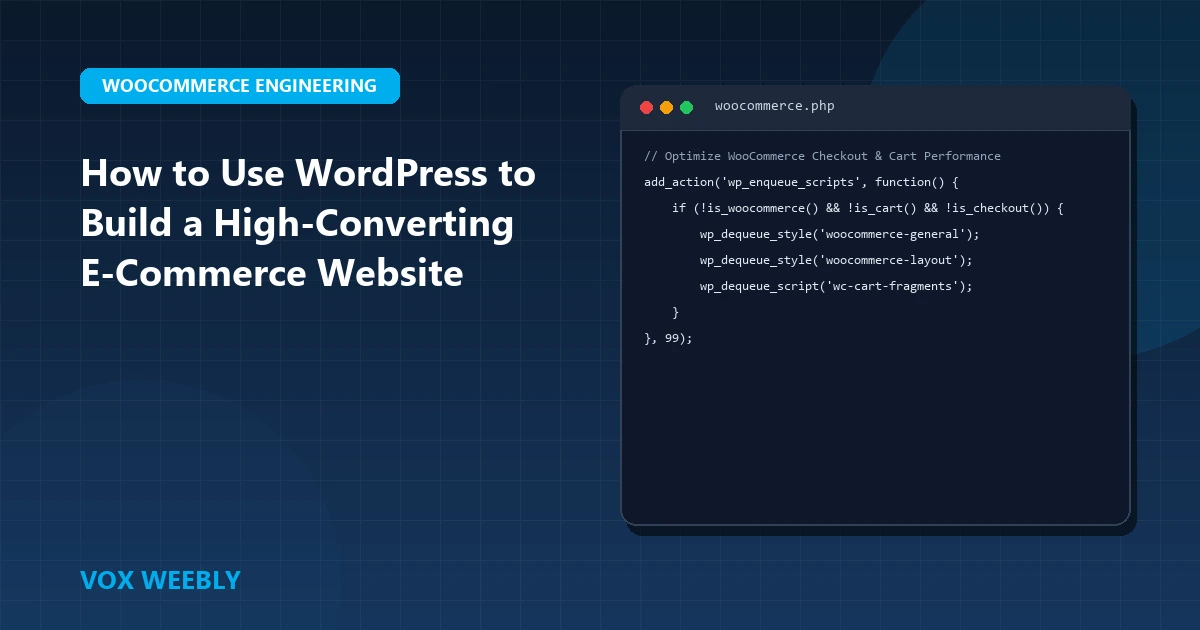
- Disable Cart Fragments on Static Pages: By default, WooCommerce triggers an AJAX request (
wc-ajax=get_refreshed_fragments) on every single page load to update the cart count in the header. On content pages and blog posts, this introduces 500ms to 1s of unnecessary delay. Dequeue this script on non-shop pages to speed up your marketing funnel. - Cloudflare Full-Page Edge Caching: Cache your homepage, category landing pages, and product archives across Cloudflare’s 300+ global edge data centers while bypassing cache automatically when cookies indicate items are present in the cart.
// Disable WooCommerce Cart Fragments on Non-E-Commerce Pages
function voxweebly_disable_cart_fragments() {
    if ( function_exists( 'is_woocommerce' ) ) {
        if ( ! is_woocommerce() && ! is_cart() && ! is_checkout() ) {
            wp_dequeue_script( 'wc-cart-fragments' );
        }
    }
}
add_action( 'wp_enqueue_scripts', 'voxweebly_disable_cart_fragments', 20 );
2. Tax, Currency & Multi-Region Shipping Setup
For US clients selling nationwide or internationally, sales tax compliance is critical. Integrate automated tax calculation tools such as TaxJar, Avalara, or WooCommerce Shipping & Tax to automatically apply accurate state, county, and municipal sales taxes at checkout. Configure shipping zones with flat rates, free shipping thresholds, and real-time carrier rates (USPS, FedEx, UPS) to avoid cart abandonment caused by unexpected shipping charges.
3. Conversion Rate Optimization (CRO) Best Practices
An aesthetically stunning store means nothing if visitors do not complete purchases. Implement these high-converting design patterns:
- Sticky “Add to Cart” Bar on Mobile: As mobile shoppers scroll through long product descriptions and customer reviews, maintain a persistent floating bottom bar with price and “Add to Cart” button for instant conversion.
- Verified Customer Reviews & Social Proof: Enable structured Product Schema with aggregate star ratings so your review stars appear directly in Google search snippets.
- Trust & Security Badges: Display SSL encryption locks, money-back guarantees, and recognized payment icons (Visa, Mastercard, Amex, PayPal) immediately adjacent to the checkout payment button.
Frequently Asked Questions About WordPress E-Commerce
Can WooCommerce handle enterprise traffic spikes (Black Friday / Cyber Monday)?
Absolutely. When paired with Redis object caching, Cloudflare CDN edge caching, and scalable cloud hosting (such as AWS, DigitalOcean, or Google Cloud), custom WooCommerce stores easily handle tens of thousands of concurrent shoppers without slowdowns.
Is WooCommerce cheaper than Shopify in the long run?
Yes. While Shopify levies ongoing transaction fees (unless using Shopify Payments) and expensive recurring app subscriptions for basic features, WooCommerce gives you 100% data ownership, zero platform transaction fees, and complete code control.
Conclusion
In conclusion, WordPress is a great platform for building e-commerce websites. With the right e-commerce plugin, theme, and setup, you can build a stunning e-commerce website that drives sales and revenue for your business. Follow the steps outlined in this guide to build your own e-commerce website with WordPress. If you need help, feel free to contact Vox Weebly, your trusted web development partner.
Vox Weebly specializes in creating beautiful, functional, and user-friendly websites for businesses of all sizes. Contact us today to learn more about our web development services.
To ensure your e-commerce store maintains peak availability during sales events, pair WooCommerce with edge caching. Review our technical guide on why Cloudflare is the best CDN for your website, and follow our diagnostic walkthrough on how to fix ‘Error Establishing a Database Connection’ in WordPress. For official WooCommerce developer APIs, refer to the WooCommerce Official Code Reference.