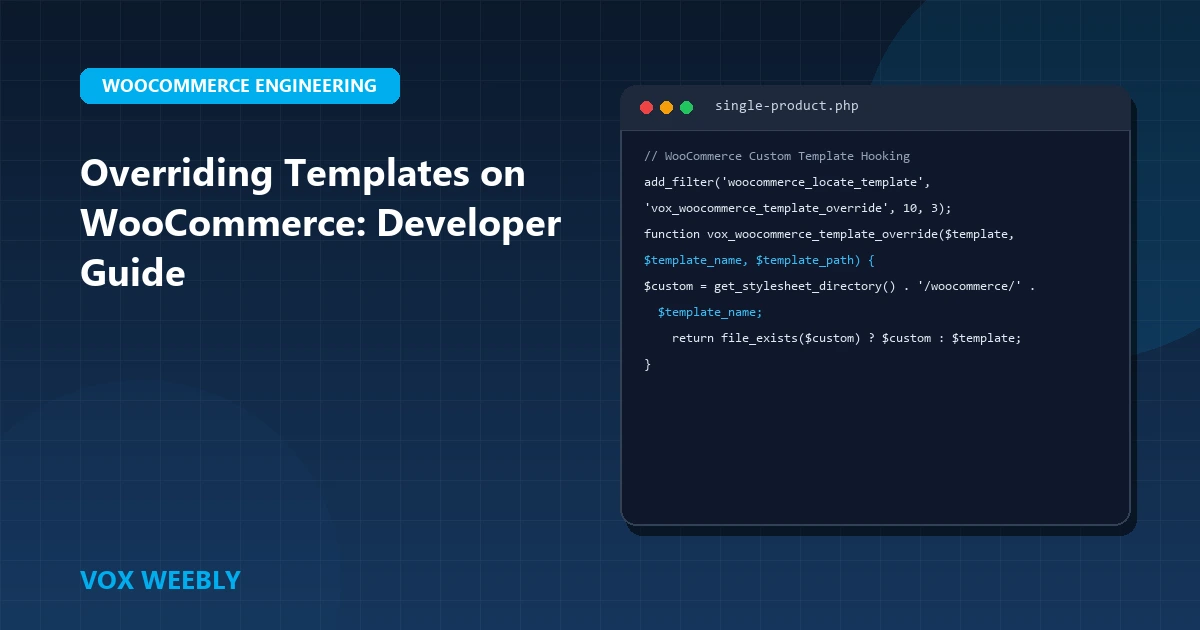
WooCommerce is the world’s most versatile open-source eCommerce platform, powering millions of online storefronts ranging from boutique direct-to-consumer brands to enterprise B2B portals. Much of this flexibility stems from WooCommerce’s modular template architecture. Every user-facing component—from single product display pages and categorized catalog archives to the shopping cart, checkout review tables, and transactional customer emails—is governed by individual PHP template files.
When developing a custom online store, off-the-shelf WooCommerce layouts rarely meet modern conversion rate optimization (CRO) standards or match bespoke agency design systems. To customize these interfaces cleanly without compromising maintainability, developers must utilize WooCommerce template overrides. In this engineering guide, we examine the mechanics of WooCommerce template overrides, explore when to favor action hooks over file overrides, and walk through production best practices for maintaining compatibility with WooCommerce updates and High-Performance Order Storage (HPOS).
Understanding the WooCommerce Template Hierarchy
WooCommerce ships with a comprehensive set of default template files located in the core plugin directory under wp-content/plugins/woocommerce/templates/. When a customer navigates your storefront, WooCommerce’s template loader checks whether your active theme provides an override for the requested template before falling back to its internal core files.
The priority sequence follows a strict hierarchy:
- Active Child Theme Override:
wp-content/themes/your-child-theme/woocommerce/[template-name].php - Active Parent Theme Override:
wp-content/themes/your-parent-theme/woocommerce/[template-name].php - Core Plugin Fallback:
wp-content/plugins/woocommerce/templates/[template-name].php
By declaring custom templates within your child theme, you ensure that core WooCommerce plugin updates can be deployed continuously without overwriting your custom styling or markup alterations.
Step-by-Step Guide: Overriding a WooCommerce Template
To safely override a WooCommerce template, follow this standard engineering workflow:
1. Identify the Target Core Template
Locate the specific file responsible for the section you wish to customize. Common template files include:
single-product.php: The top-level wrapper template for individual product pages.single-product/add-to-cart/simple.php: Controls the quantity selector and Add to Cart button for simple products.cart/cart.php: The customer shopping cart table and totals layout.checkout/form-checkout.php: The primary checkout form wrapper encompassing billing and shipping fields.checkout/review-order.php: The order review table displaying cart items, taxes, shipping rates, and totals.emails/customer-completed-order.php: The transactional HTML email dispatched upon successful order fulfillment.
2. Replicate the Directory Path in Your Child Theme
Inside your active child theme directory, create a subfolder named exactly woocommerce. Copy the target core template into this folder, preserving the exact relative subfolder structure.
For example, to override the checkout review order table:
# Source Core File:
wp-content/plugins/woocommerce/templates/checkout/review-order.php

# Destination Child Theme Override:
wp-content/themes/voxweebly-child/woocommerce/checkout/review-order.php
3. Implement Your Custom Markup
Open the copied file in your code editor. You can now modify HTML elements, adjust CSS class attributes, insert custom micro-copy, or integrate custom ACF product specifications. WooCommerce will automatically load your child theme’s file instead of the core version.
Critical Warning: Never edit files directly inside wp-content/plugins/woocommerce/. Any direct core modifications will be permanently erased during the next automated or manual WooCommerce update, breaking your storefront instantly.
Template Overrides vs. Action & Filter Hooks: Which Should You Use?
While template overriding is powerful, experienced WooCommerce architects favor Action and Filter Hooks whenever possible. Core WooCommerce templates are filled with dynamic action hooks that allow you to inject, rearrange, or delete content programmatically from your child theme’s functions.php file without maintaining a full file override.
Why Hooks Are Superior for Minor Customizations
- Zero Maintenance Overhead: When WooCommerce releases a major version update, template files often receive markup tweaks or new security tokens. If you override a template file, you must manually inspect diffs and update your template. With hooks, your code remains 100% compatible across major WooCommerce updates.
- Cleaner Version Control: Managing customizations in modular PHP hook functions creates cleaner Git commit histories compared to maintaining dozens of full template duplicates.
Example: Modifying Product Summary via Hooks
Instead of copying content-single-product.php just to move the product price or display a custom shipping notice, you can hook into existing WooCommerce actions:
// Add a custom trust badge and free shipping notice below product price
add_action( 'woocommerce_single_product_summary', 'voxweebly_render_trust_badges', 15 );
function voxweebly_render_trust_badges() {
echo '<div class="custom-product-trust-badge">';
echo '<span>✓ Guaranteed Next-Day Dispatch</span>';
echo '<span>✓ Free 30-Day Hassle-Free Returns</span>';
echo '</div>';
}Managing Outdated Template Warnings in WooCommerce Status
Whenever you override WooCommerce templates, the WooCommerce System Status report monitors your files against core versions. At the top of each core WooCommerce template file, a version tag is declared (e.g., @version 7.0.1).
When a WooCommerce core update updates a template file (such as incrementing to @version 7.4.0), WordPress will display an admin notice: “Your theme has bundled outdated copies of WooCommerce template files.”
To resolve this alert:
- Navigate to WooCommerce > Status > System Status and scroll to the Templates section.
- Identify which template file has a version mismatch warning.
- Compare your child theme’s customized template against the newly released core WooCommerce file using a visual diff tool (like VS Code diff or Git diff).
- Incorporate any new core arguments, security nonces, or hooks into your custom file.
- Update the
@versionheader comment in your custom file to match the new core version.
Ensuring Compatibility with High-Performance Order Storage (HPOS)
Modern WooCommerce architecture utilizes High-Performance Order Storage (HPOS), storing orders in dedicated, normalized database tables (wp_wc_orders) rather than standard wp_posts and wp_postmeta. When overriding checkout and order-received templates, always use native WooCommerce CRUD getters (such as $order->get_id(), $order->get_billing_email(), and $order->get_meta()) rather than legacy WordPress functions like get_post_meta() to guarantee HPOS database acceleration.
Conclusion
Overriding WooCommerce templates provides online store owners and digital agencies with unrestricted freedom to craft bespoke, high-converting eCommerce experiences. By organizing template overrides cleanly within a child theme, development teams protect custom styling from plugin updates while maintaining full control over layout semantics, responsive behavior, and checkout architecture.
However, engineering excellence requires balance: wherever possible, prioritize WooCommerce action and filter hooks for targeted layout tweaks, reserving full file overrides for complex structural redesigns. Staying proactive with WooCommerce System Status audits and maintaining HPOS-compliant code guarantees that your eCommerce store remains blazing fast, secure, and future-proof.
If your enterprise needs a bespoke WooCommerce store engineered for speed, custom checkout conversions, and high-concurrency order volumes, partner with Vox Weebly. Explore our custom WooCommerce development services or hire dedicated senior WooCommerce engineers to build your store today.
Frequently Asked Questions (FAQ)
Why should I override WooCommerce templates in a child theme?
Editing core WooCommerce plugin files directly is dangerous because all custom modifications will be permanently erased during the next plugin update. Overriding templates inside your child theme ensures updates never break your custom checkout designs.
How do I safely customize the WooCommerce checkout page?
Use WooCommerce action hooks (e.g. woocommerce_before_checkout_form) and filter hooks rather than replacing entire template files whenever possible. This maximizes compatibility with payment gateways and prevents outdated template conflicts.
What does the “outdated WooCommerce template files” warning mean?
This warning indicates that WooCommerce released a plugin update containing changes to a core template that you have overridden in your child theme. You must compare your custom file with the new core version, integrate any new hooks or security tokens, and update the @version comment in your template header.
Can Vox Weebly build custom WooCommerce extensions and checkouts?
Yes. Our senior WooCommerce engineers build bespoke product customizers, frictionless single-step checkouts, and custom API syncs for high-volume stores. View our WooCommerce development services or contact us for a consultation.