Understanding how visitors discover, navigate, and convert across your digital web properties is the bedrock of modern data-driven marketing. With Google’s complete sunsetting of Universal Analytics in favor of Google Analytics 4 (GA4), website owners and digital marketing executives must navigate a completely redesigned event-based measurement model, streamlined user journey reports, and machine-learning attribution paths. In this comprehensive, step-by-step technical guide, we break down the Google Analytics interface, custom exploration reports, conversion event tracking, and privacy-first measurement tactics.
1. The Shift to GA4: Event-Based Measurement
Universal Analytics relied on a legacy session-based tracking model that categorized interactions into discrete pageviews, e-commerce transactions, and screen events. By contrast, Google Analytics 4 treats every single interaction as a distinct event.
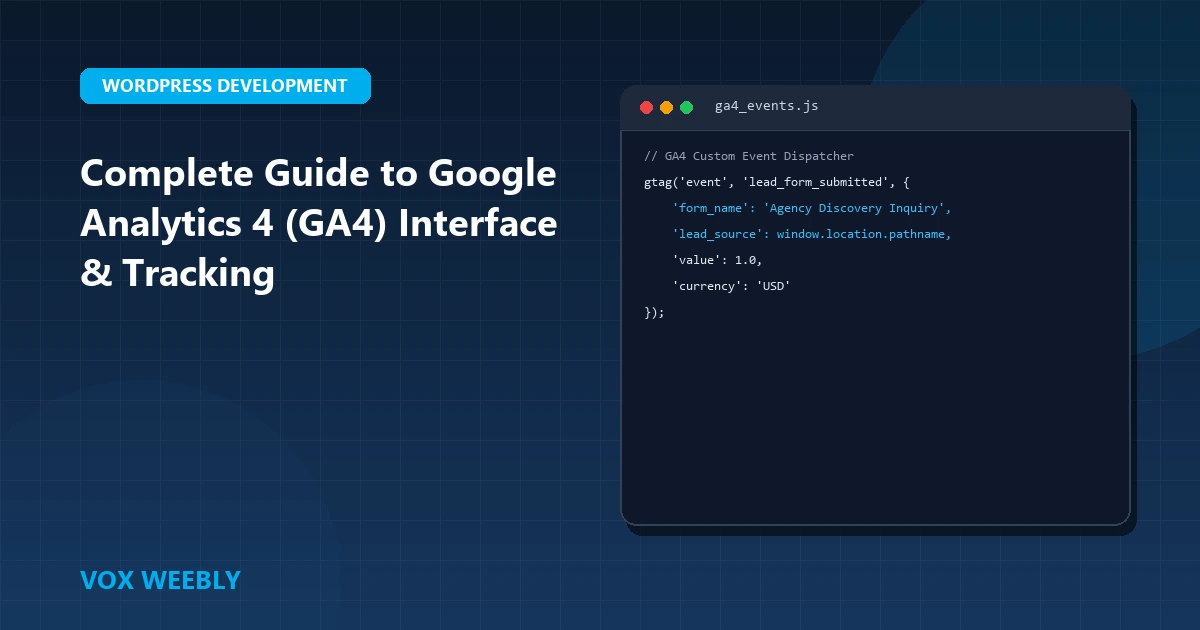
Whether a visitor views a page (page_view), scrolls 90% down an article (scroll), clicks an outbound link (click), or submits a lead form (form_submit), GA4 records each action as an independent event accompanied by custom parameters. For official developer documentation, visit the Google Analytics Official Developer Documentation.
2. Navigating the GA4 Dashboard Architecture
The GA4 user interface is organized into five primary functional modules located in the left-hand navigation bar:
- Home: Provides high-level snapshot cards of real-time active users, top traffic channels, and AI-driven anomaly insights.
- Reports: The core operational reporting workspace, divided into Life cycle (Acquisition, Engagement, Monetization, Retention) and User (Demographics, Tech) collections.
- Explore: The power-user workspace for building custom drag-and-drop funnel analyses, path explorations, and cohort charts.
- Advertising: Delivers cross-channel attribution modeling, conversion path breakdowns, and Google Ads ROI performance.
- Admin: Manages account permissions, data streams, custom dimensions, and data retention windows.
3. User Acquisition vs. Traffic Acquisition Reports
One of the most frequent sources of confusion in GA4 is the distinction between User Acquisition and Traffic Acquisition:
- User Acquisition (First User Source/Medium): Measures how a new visitor originally discovered your website for the very first time in their lifecycle.
- Traffic Acquisition (Session Source/Medium): Measures what marketing channel brought the visitor to your website for their current active session.
To optimize your site for maximum organic search acquisition, follow our technical walkthrough on how to optimize WordPress for SEO.
4. Configuring Custom Events & Key Conversions
Under Admin > Data Display > Events, you can create custom event triggers directly inside the interface without touching theme code. For example, to track submissions on your contact page:
Event Name: generate_lead
Matching Conditions:
  event_name equals page_view
  page_location contains /thank-you/
Toggle the Mark as key event switch to designate this action as a primary commercial conversion for attribution reporting.
5. Building Advanced Funnel Explorations
Standard reporting tables often fail to illustrate where users drop off during multi-step customer journeys. Navigate to Explore > Funnel Exploration. Here you can define sequential step milestones (e.g. Landing Page > Services > Consultation Form > Thank You Page) to visualize precise drop-off percentages and eliminate UX friction.
6. Privacy Compliance & PageSpeed Performance Impact
Third-party tracking scripts can introduce render-blocking bottlenecks that degrade Google Core Web Vitals. Always load Google Tag Manager asynchronously and defer non-critical analytics beacons until user interaction. Review our performance benchmarks on disabling lazy loading on hero images, and protect your domain against transport snooping with our guide on adding HTTP security headers in WordPress.
7. Server-Side Tracking & Cloudflare Zaraz for Sub-Second TTFB
While client-side Google Analytics tagging via gtag.js is straightforward to install, it introduces measurable performance overhead. Loading multiple third-party JavaScript libraries increases main-thread blocking time, delays First Contentful Paint (FCP), and impairs your site’s Cumulative Layout Shift (CLS) scores. Furthermore, client-side tracking is increasingly vulnerable to browser ad-blockers, tracking protection extensions, and Apple Safari’s Intelligent Tracking Prevention (ITP), which restricts third-party cookies and caps first-party cookie longevity to as little as 24 hours.
Enterprise organizations solve these challenges through Server-Side Tagging:
- Server-Side Google Tag Manager (sGTM): Instead of user browsers executing dozens of tracking scripts, a single lightweight payload is transmitted to your own server-side proxy endpoint (e.g.,
https://data.yourdomain.com/collect). The server container validates, cleanses, and dispatches the data to Google Analytics 4, Meta Conversions API, and advertising networks simultaneously. - Enhanced First-Party Cookie Longevity: Because tracking cookies are issued directly from your custom domain over HTTPS, Safari and Firefox recognize them as genuine first-party session identifiers, preserving attribution windows for multi-touch conversions over 30 to 90 days.
- Cloudflare Zaraz Edge Execution: For ultimate speed, Cloudflare Zaraz executes Google Analytics triggers directly on Cloudflare edge worker nodes without loading external JavaScript files in the visitor’s browser. This achieves 100% data capture accuracy while maintaining a sub-second Time to First Byte (TTFB).
Conclusion
In conclusion, mastering a complete guide on how to use the google analytics interface in 2023 is essential for building a resilient, high-performing WordPress website. By implementing the architectural best practices and configurations covered in this guide, you ensure your platform maintains peak performance, bulletproof security, and seamless user experiences.
Continuously auditing your server configurations, monitoring error logs, and adhering to clean development standards will keep your site reliable as your business scales. Investing in high-performance hosting and modern engineering prevents costly downtime and maximizes your digital investment.
At Vox Weebly, we understand the importance of a fast, secure, and custom-engineered WordPress website, and our team of senior developers can help you build, optimize, and maintain your web platform for maximum performance. Contact us today to learn more about our custom WordPress website development services.
7. Frequently Asked Questions (FAQ)
How long does GA4 retain user-level event data?
By default, GA4 sets event data retention to only 2 months. Immediately navigate to Admin > Data Settings > Data Retention and switch the setting to 14 months to preserve historical comparison data.
Can GA4 track website downtime or database connection errors?
GA4 cannot track server downtime because tracking scripts do not load when the server is offline. Use external uptime monitors (like UptimeRobot) and follow our guide on fixing database connection errors.